
Compass
Scaled residential brokerage platform positioned to benefit from three-phased marketing, proprietary listing data, agent recruitment, and a cyclical recovery in existing home sales.
COMP can compound share in a structurally changing brokerage market while monetizing listing data and ancillary services; a mid-cycle housing recovery and modest market-share gains create a path to roughly triple the current share price.
- Price
- $7.85
- EHS SAAR
- 3.98m
- Mid-cycle EHS case
- 5.0m
- Mid-cycle value
- ~$12
- Potential value
- $30.22
- Short interest
- 6.3% of float
Abstract
As the leading residential real estate brokerage in the U.S., Compass, Inc. is catalyzing a structural change in an otherwise fragmented and undifferentiated industry. COMP is leveraging its scale to alter the way properties are marketed and to recapture the value of its data. The result of COMP's recent initiatives is that it has created a flywheel by which it can win more home listings, attract more buyer clients, and recruit and retain more agents. Over time, we expect this strategy to result in persistent market-share gains and data monetization opportunities. We also see significant upside from an eventual cyclical rebound in housing transactions. COMP shares can triple as this all unfolds.
Business description
COMP is the leading residential real estate brokerage firm in the U.S., with a national market share of just under 20%. With 340,000 agents globally, COMP is more than double the size of its next closest competitor, RE/MAX. COMP owns brokerages that operate under the Coldwell Banker, Compass, Corcoran, Sotheby's International Realty and @properties brands. It also owns franchises that operate primarily under the Better Homes and Gardens Real Estate, Century 21, Christie's International Real Estate, Coldwell Banker, Coldwell Banker Commercial, Corcoran, ERA, and Sotheby's International Realty brands.
COMP also offers an array of complementary products and services, such as mortgage, title, escrow, and relocation through its family of brands.
Industry structure
The residential real estate brokerage industry in the U.S. has historically been fragmented but is rapidly consolidating. Prior to the January 2026 merger of Compass with Anywhere Real Estate, no single firm had more than roughly 10% market share, with most of the top firms sitting well below that level. The January 2026 combination with Anywhere creates a company with real scale on a national level, but that understates the company's position in many of the most important markets.
According to Senators Warren and Wyden, COMP now possesses a 70% market share in parts of Northern California and a 40% share in New York City¹. The Consumer Policy Center estimates that COMP now has 30% market share or more in Boston, D.C., Chicago, San Diego, and Austin². COMP's newfound dominance is a significant structural change in the industry that may trigger further consolidation and alter the way real estate is marketed throughout the United States.
1https://www.warren.senate.gov/imo/media/doc/20251216lettertodojandftconmergerbetweencompassincandanywhererealestateinc.pdf
2https://consumerpolicy.org/wp-content/uploads/Compass-Market-Report-4.15.26.pdf
3-phased marketing
While we acknowledge that the real estate brokerage business is subject to the vicissitudes of the housing market, we see several opportunities for COMP to create value for shareholders regardless of the environment. First, we believe that COMP will organically gain market share due to its unique value proposition to both consumers and agents. COMP initiated a "3-Phased Marketing Strategy" that offers sellers the ability to:
- Make the listing available exclusively to agents affiliated with COMP without placing the property on the Multiple Listing Service. These are known as "Compass Private Exclusives."
- Feature the property on Compass.com and Redfin.com as a "Compass Coming Soon" listing without accruing days on market or subjecting it to a recorded price-drop history.
- Go live on the MLS for broad dissemination of the listing after incorporating the insights gleaned from phases 1 and 2.
We believe three-phased marketing will become the industry standard, as it offers a seller the ability to gather information about pricing, staging, and other variables without formally hitting the MLS and accruing days on market and price-drop history, while at the same time allowing sellers a modicum of privacy and the optionality to accept an attractive offer. Recent academic research supports this view, as it indicates that private listings actually lead to superior outcomes for sellers than traditional marketing via the MLS³. While many competitors and pundits have vilified private listings, citing issues with fair housing policy and transparency, we see no merit to their claims.
Three-phased marketing closely resembles the process used when selling most other types of large, illiquid assets, such as commercial real estate or businesses, and it represents an overdue innovation in the market for sellers. Roughly two decades ago, firms like Zillow and Realtor.com gave prospective buyers access to the nearly 600 MLSs in the U.S. and provided them with insights like previous sale prices, valuation estimates, school ratings, and days on market. Three-phased marketing shifts the balance of power back toward the seller, and we expect it to resonate. With a differentiated value proposition, we expect COMP to capture significant listing share over the coming years.
Several other brokerages have adopted some form of the 3-Phased Marketing Strategy, but only COMP offers the ability to share its Private Exclusives with agents who collectively facilitate 20% of all real-estate volume and as much as 70% of all real-estate transactions in certain markets. No other firm comes close to this breadth of internal distribution of off-MLS listings and, without some level of scale, Private Exclusives would likely fail to deliver much value to sellers.
Moreover, in phase 2, COMP offers sellers a unique opportunity to promote their properties on Redfin.com, a site with 60MM monthly active visitors, with priority placement in search results. COMP also inked a deal with Rocket Mortgage, the largest mortgage lender in the U.S., to offer prospective buyers of Compass Coming Soon listings a one percentage point discount off of Rocket's advertised mortgage rate for the first year of the loan. To put this into perspective, for a typical COMP transaction, a 100bps reduction in the buyer's mortgage rate could translate into savings of $8,000 or more. These collectively represent a significant incentive for sellers seeking a three-phased marketing approach to list their homes with COMP.
3https://papers.ssrn.com/sol3/papers.cfm?abstract_id=6359754
An industry undergoing structural change
This is just the beginning for COMP. Private Exclusives not only win listings; they stimulate interest from buyers to work with COMP agents. All else equal, we believe buyers will be compelled to work with an agent who has access to the most inventory. Said differently, buyers not working with a COMP agent could be missing a material portion of a local market's available inventory. This is not yet well understood by the public. Once it is, COMP is likely to see a large uptick in buy side market share, as well.
Consider that one of Zillow's most popular features is its alerts, which notify a prospective buyer of new inventory when it hits the MLS. If buyers care about finding the newest listings, then it is reasonable to believe that they will feel compelled to work with a COMP agent. Other brokerages will have exclusive, off-market inventory, but no firm will have as much proprietary inventory as COMP. Recognizing this, it is easy to understand why other, smaller brokerages are mostly opposed to COMP's three-phased marketing strategy. They simply cannot compete with it.
Because COMP is able to offer unique value to both sellers and buyers, COMP also offers the most value to agents of any brokerage. Residential real estate brokerage has been a mediocre business for many decades, as there are no significant barriers to entry and it has been hard to differentiate on anything other than agent splits, which is the portion of the commission shared with the broker versus the agent, or bonuses. Brand has mattered to a small extent, but the mobility of successful agents suggests that the brand of the individual tends to matter more than the brand of the brokerage.
COMP's newfound scale and differentiated marketing strategy change that dynamic. COMP's ability to offer Private Exclusives and preferential placement on Redfin.com give agents tools to win more listings and attract more buyers than any other brokerage. The result of COMP's recent initiatives is that it has created a flywheel by which it can win more listings, attract more buyer clients, and recruit and retain more agents. Over time, this should result in continued market-share gains as well as relieve pressure on agent splits. By creating this flywheel, COMP has positioned itself to regain negotiating leverage with agents.
The value of the listing data is clear
Capturing a greater share of the value of real-estate commissions is only one part of COMP's opportunity. As the leading brokerage in the U.S., COMP also possesses more valuable data than any other residential real-estate firm. Each new listing that COMP wins creates valuable data that it can monetize. This represents a meaningful change in the industry paradigm.
A look back at the roots of Zillow helps explain why this is the case. In the mid to late 2000s, online portals that democratized listing data became extremely popular with consumers. Zillow and others built valuable businesses by gathering listing data from the various MLSs at virtually no cost and selling buyer-agent leads back to the very same brokerages that produced the listing data.
Prescient brokers and agents warned that this free sharing of MLS data would enable the creation of powerful adversaries, but the fragmented nature of the brokerage industry made it easy to exploit. Until this year, no single brokerage firm was large enough to mount a challenge to Zillow's business model, and while brokerages often lamented ceding such power and influence to Zillow, they suffered from a collective-action problem. Fierce competition and pervasive distrust prevented brokers from organizing around this common cause. Even initiatives supported by trade groups, such as the National Association of Realtors' Project Upstream, suffered from poor execution and half-hearted member support. However, with COMP now controlling a material portion of the listings in most major U.S. markets, the industry structure has changed.
We expect large brokers, led by COMP, to start recapturing the value of their data. Redfin's partnership with COMP is an early example of this, and Zillow Preview, whereby Zillow promotes Coming Soon listings and shares its lead-generation economics with the listing brokerage, is another. Further consolidation among brokerages would only serve to accelerate this industry shift.
While Zillow retains a dominant position in home search, it clearly sees the risks posed by COMP's 3-Phased Marketing Strategy. In April 2025, Zillow announced listing access standards, which was an effort to ban any MLS listing that began its life as a Private Exclusive or equivalent⁴. Zillow was concerned about having incomplete data and having COMP, in particular, establish itself as a competing destination for home search. According to court filings, Zillow offered Compass between $1.3B and $1.6B in financial incentives to display Compass Private Exclusives on Zillow. Recognizing the value of its proprietary data, COMP rejected the offer.
We see a world in which Compass.com either becomes a mandatory destination for home searchers or gets paid for the data it provides to other portals. Perhaps in the not-so-distant future, there will be no real-estate portals, and search will all happen through AI assistants and LLMs. In a world where AI agents act as the front door to the Internet, it is plausible that searches will lead directly to a brokerage's website. With the largest number of listings, COMP's web properties are positioned to receive the most organic traffic from these sources. This would lead to more opportunities to win buyer-agency assignments and cross-sell affiliated products, such as mortgages, just as the top portals do today. While this is long-term optionality, given the 10-figure offer from Zillow, the potential value is clearly significant.
4To be precise, Zillow sought to ban any listing that was publicly-marketed and not placed on the MLS within one business day. It has since softened its stance to allow for placement on the MLS within the timeframe prescribed by that MLS
Ancillary services
Growth in revenue from ancillary services is a real opportunity as well. Title and escrow were immaterial to COMP's 2025 revenue, which we take to mean less than 5% of total, but HOUS was more mature in this area. In total, HOUS brings nearly $400MM in annual ancillary revenue to COMP, making title and escrow a substantial stand-alone business now.
HOUS has disclosed a 31% attachment rate for title and escrow in its owned brokerage operation⁵, which places it among the top performers in the industry. Thanks to its One-Click Title & Escrow offering, COMP has been increasing its attachment rate rapidly over the last several quarters, but we believe there is still room for COMP to improve to HOUS's level. At the same time, rolling out the one-click feature to the legacy HOUS operations is likely to drive further improvement there.
Redfin had a stated goal of reaching 50% attachment for mortgage and title. If COMP were to reach that level, we estimate it would drive an incremental $750MM in annual revenue and $500MM in annual EBITDA⁶. COMP agents are present at a moment of tremendous change for their clients, so they are uniquely positioned to assist with these and a variety of other services related to moving and owning a new home.
Ultimately, COMP sees a total addressable market of more than $150 billion from these add-on services and others, such as solar and home security for consumers and digital ads and 3-D renderings for agents. Just 1% penetration of this TAM would roughly triple COMP's ancillary business.
5HOUS 2024 Form 10-K
6Assumed incremental margin of 67% based on HOUS historical results
Cyclicality as a tailwind
Nothing in real estate is easy, but these value-creation opportunities are clear, and they rely primarily on continued execution by COMP management. However, there is another significant value driver that is out of COMP's control, and that is the level of existing home sales. EHS are currently near the lowest level seen in two decades. At a seasonally adjusted level of 3.98MM transactions, the market is bouncing along a bottom that former Redfin CEO Glenn Kelman described as a floor due to natural changes in life circumstances, such as births/deaths, marriages/divorces, and job changes.
The housing market is cyclical and inversely correlated with interest rates, so EHS seldom remain at a normal level. However, it is easy to imagine substantial upside to EHS at some point, and COMP would be a direct beneficiary.
Based on our estimates⁷, at a level of 5MM annual EHS, COMP would participate in 23% more transactions, generate an incremental $3B in annual revenue at 20% incremental margins, and roughly double the EBITDA of the business. This is not an upside case. It is merely a return to a mid-cycle level of EHS, and it excludes the impact of the other initiatives under way at COMP. We are excited about the idiosyncratic opportunities ahead of COMP, but a tailwind from the housing market could also create serious value.
Figure 1: U.S. Existing Home Sales, Seasonally Adjusted
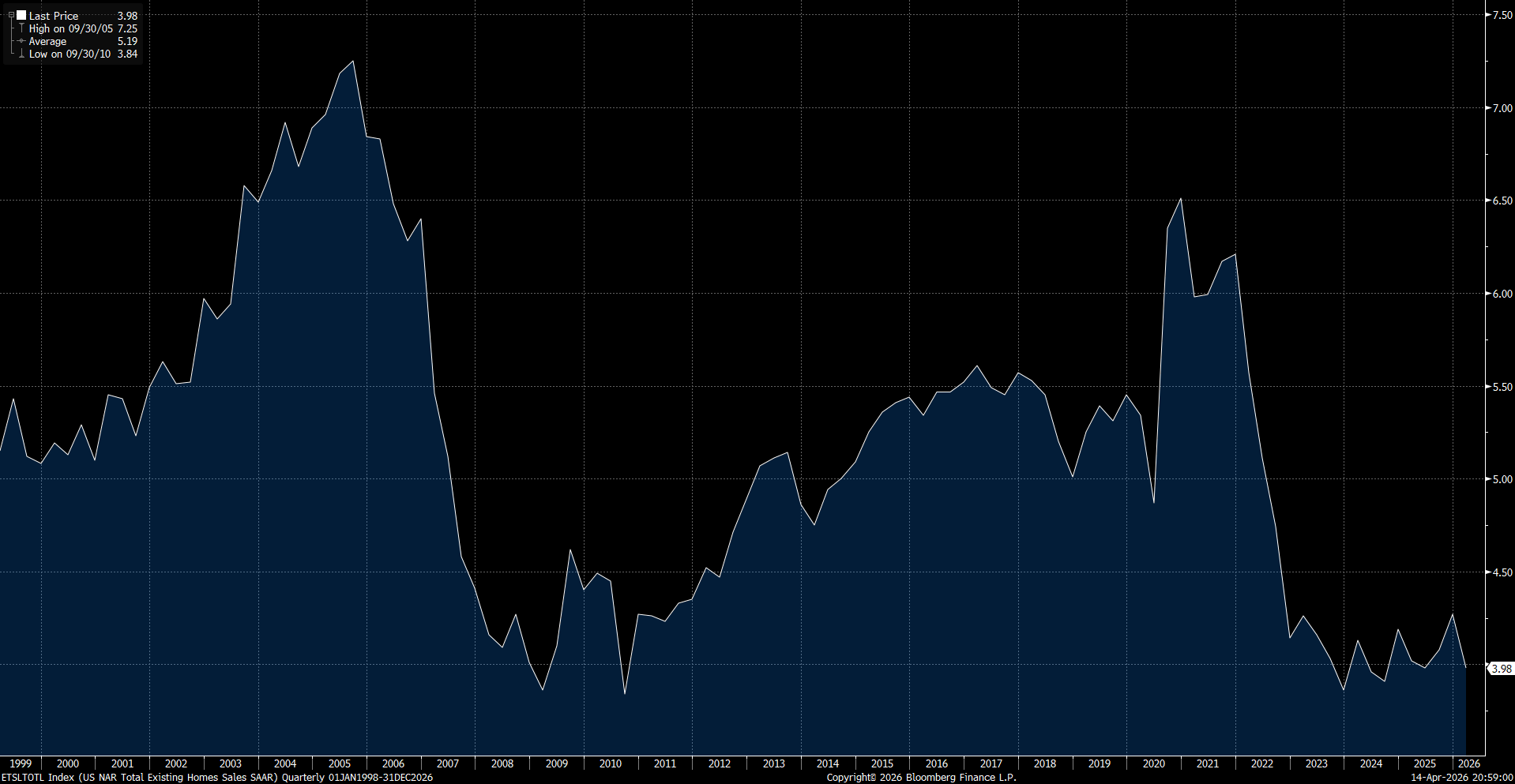
Source: Bloomberg
7Assuming constant market share.
Appraisal of value
COMP is operating in a cyclically-depressed housing market, so we care less about near-term earnings and cash flows than we do about mid-cycle or long-term earnings power. However, if we use the consensus 2026 EBITDA estimate of $741MM, COMP currently trades at just over 12X EBITDA. By our math, if COMP were to maintain its market share and EHS were to increase to 5MM units, its EBITDA would be ~$1.3B excluding HOUS synergies. At 10X that $1.3B of EBITDA, which we view as a reasonable mid-cycle multiple for a category-leading business with excellent growth prospects, that would imply a share price of ~$12, roughly 50% higher than the current share price.
If, in addition, COMP is able to achieve its forecasted synergies related to its acquisition of HOUS, that would imply an additional $4-5 per share of value. As discussed above, we also see tremendous potential for COMP to garner more share of EHS as it executes on its strategy. As shown in Figure 2, each percentage point of market share on a 5MM-unit market is worth ~$565MM of EBITDA to COMP, or about $7 per share.
Taken together, as shown in Figure 3, we see potential for COMP's share price to more than triple from the current price.
While we use an EV/EBITDA framework because that is the metric most frequently cited for valuation of real estate brokerages in our experience, a free cash flow valuation approach provides a sanity check. COMP, as a stand-alone business, produced $200MM of FCF in 2025, while HOUS broke even on FCF, primarily due to high interest expense. If COMP delivers on its projected deal synergies, that would raise FCF for the combined entity to $600MM⁸, which would represent an 11% FCF yield on COMP's current market cap. A double-digit FCF yield strikes us as attractive on a business with both cyclical upside and idiosyncratic value-creation potential.
We should note that COMP assumed about $2.5B of debt with its purchase of HOUS. While the debt is laddered and has several years before the first maturity date, it is still more debt than we would prefer. Regardless of what we learned in business school about capital structure optimization, our lived experience tells us that cyclical businesses with more than a modicum of debt typically trade at depressed multiples. As COMP uses its FCF to repay this debt over time, we believe its EV/EBITDA multiple will increase.
Figure 2. COMP sensitivity to changes in EHS
Sensitivity Analysis:
| INCREMENTAL MARKET SHARE | 0.00% | 0.50% | 1.00% | 1.50% | 2.00% |
|---|---|---|---|---|---|
| Adjusted EBITDA | $ 1,266,350,982 | $ 1,548,663,480 | $ 1,830,975,977 | $ 2,113,288,474 | $ 2,395,600,972 |
| Incremental EBITDA | $ - | $ 282,312,497 | $ 564,624,995 | $ 846,937,492 | $ 1,129,249,989 |
| Incremental Value per Share | - | 3.49 | 6.97 | 10.46 | 13.94 |
Source: HST Ventures, LLC
Figure 3. Potential value per COMP share
| Current share price | $7.85 |
| + Synergies | $4.50 |
| + Mid-cycle EHS | $4.54 |
| + Market-share gain of 1 ppt. | $6.97 |
| + Title opportunity | $6.36 |
| = Potential value per share | $30.22 |
Source: HST Ventures, LLC
8COMP has significant net operating losses at the federal and state levels, which should shield these synergies from taxes for several years. COMP has advised analysts that roughly half of the synergies realized in 2026 will come from capex, namely a reduction in the capitalization of software development. Because these capitalized expenses may have been amortized over several years for tax purposes, the analysis of the tax impact of these synergies is complicated.
Management quality and incentives
COMP is led by its founder, Robert Reffkin. Unsurprisingly, Reffkin is a charismatic leader who is perfectly suited to run a large sales organization such as COMP. However, based on our numerous interactions with him, Reffkin is an unusual blend of substance and style. According to his colleagues, he is an impact-driven CEO who is focused on improving the lives of his agents and delivering value to clients and shareholders.
What strikes us is his intense strategic focus. While he spends a shocking amount of time in the field, visiting offices and open houses, he has a vision for his business that transcends operational excellence. That vision includes many of the initiatives discussed herein, namely delivering choice to home sellers in the way they market their homes and recapturing the value of listing data for COMP and its agents. From what we have observed, Reffkin is relentlessly focused on these two objectives.
Reffkin owns 18.5MM shares of COMP stock and receives roughly 80% of his compensation in company shares. Notably, Reffkin's holdings were worth about $500MM at the time of the company's IPO, so we doubt that he is satisfied with the company's current valuation.
CFO Scott Wahlers and his predecessor, Kalani Reelitz, have done an admirable job of reducing and controlling expenses, ultimately taking a business that many pundits said would never make money and turning it profitable in an otherwise soft environment for housing. Rory Golod, President of Growth and Communications, is another impressive executive who we regard as one of the best recruiters of agents we have ever encountered.
From top to bottom, the COMP team possesses strong talent, and that does not even consider the quality of COMP's agents. In 2025, COMP's principal agents averaged 12 transactions and nearly $13MM of volume, both of which are well in excess of the industry averages.
AI and technological disruption
COMP, like many other brokerage business models, has been identified as a business that could be impacted by technological changes, namely AI. The AI fears, in general, surround the ability of an AI assistant to do the work of a human agent, a realtor, in assisting a consumer in buying or selling a home. While buyer agency strikes us as the more plausible opportunity for an AI assistant, even sell-side agents have been identified as vulnerable to displacement. In a recent news story, a Florida man used ChatGPT to complete the sale of his home without the assistance of an agent.
While we find it highly likely that AI will perform many functions of an agent, such as preparation of comps, completion of forms, and other market analyses, we believe it will take many years before a seller is willing to trust AI with his most valuable asset, do the legwork that the AI assistant still requires, rely on the AI's ability to identify what makes a property special, and provide the salesmanship which is often necessary to close a transaction.
Real estate agents predominantly work on commission, and salaried agents have been shown to underperform their commissioned counterparts due to their relatively lower motivation to do whatever it takes to complete a transaction. Redfin primarily employed salaried agents for more than a decade and ultimately decided that it could not attract and retain the best talent to that model, because the most motivated agents all wanted to work on commission.
Will the AI be similarly motivated to complete a deal? Will it possess the skill and emotional intelligence to finesse a difficult transaction? Will human buyers find the AI annoying? Will it be able to conduct an effective showing, since it cannot be there on site? In the fullness of time, the answer to these questions may be yes, but we expect adoption to take a long time. Real estate tends to be an emotional, high-stakes transaction.
Theoretically, the technology to eliminate human agents from the home-sale process has been available for many years. Real-estate auctions could easily be conducted online and without representation, but none has ever captured any meaningful share of residential home transactions. Automated valuation models, like Zillow's Zestimate, have been available for a decade to use machine learning to appraise the value of real estate, yet few consumers would trust it to set the value of a home purchase, and Zillow lost more than a billion dollars relying on the same models to purchase homes for its own account.
Redfin has offered a tech-enabled buyer-agency solution where a website can coach a buyer through the home-buying process, including writing offers and negotiating documents, but the solution got almost no traction. Smart-home technology allows sellers to conduct showings with no agent present. Still, in 2025, 91% of home sellers and 88% of home buyers chose to use a realtor to complete their transaction.
Complexity and heterogeneity represent additional challenges for AI to manage. No two deals are alike, and the human agent possesses flexibility and motivation to solve problems that would otherwise prevent a deal from getting done. That said, in the fullness of time, all job functions are at risk of being displaced by AI and robotics. COMP's strategy to focus on winning listings gives it a relative advantage in fending off competition from AI.
From our perspective, a buyer agent is more susceptible to displacement than a listing agent. Compared with listing agents, buyer agents simply have fewer responsibilities. They do not have to prepare disclosures, plan staging, coordinate photos, develop a marketing plan, conduct showings, and hold open houses. Of course buyer agents perform many valuable services, but it is just harder for AI to perform sell-side tasks than to evaluate options, recommend vendors, appraise values, coordinate showings, and prepare documents, tasks that we generally associate with buyer agents.
AI seems better positioned to replace buyer-agent job functions. Moreover, we believe the brokerage's brand matters considerably more on the sell side. A seller aligns his property with that brokerage, and the broker's imprimatur and network of agents actually matter to the sale of the property. This is especially true in a world of private listings. Consequently, we believe that COMP is relatively well positioned to fend off challenges from AI solutions. Portals, which focus almost exclusively on monetizing buyer-agent leads, and the brokerages that rely heavily on lead flow from them, seem far more vulnerable to AI challenges than COMP.
Consideration of exogenous factors
Legal. The real estate industry has endured many legal challenges over the last decade, including antitrust challenges from the Department of Justice, civil actions from plaintiffs alleging collusion among brokers in setting buyer-agent commissions, and private lawsuits between brokers and portals. Substantially all of these cases have been settled, and COMP is no longer a party to any material litigation. Importantly, the civil litigation between home purchasers and the National Association of Realtors regarding buyer-agent commissions was resolved without any major changes to industry practices. In the 18 months following these settlements, buyer-agent commissions have remained stable, putting to rest one of the major secular risks facing the brokerage industry. In 2025, COMP challenged Zillow's lifetime ban on certain off-market listings in court, alleging monopolistic behavior. Zillow ultimately altered its stance on such listings with its launch of Zillow Preview, so COMP dropped its lawsuit. While the real estate industry is in a period of significant change, the legal environment appears more stable than it has been in many years.
Interest rates. COMP's business is inextricably linked to long-term interest rates. We have no edge in predicting the direction of long-term rates, but we do believe that COMP has more upside than downside to this variable. COMP has already endured a rise in the 10-year U.S. Treasury yield from 0.5% to 5.0% and has continued to grow its sales volume and improve its profitability. Lock-in from low-rate mortgages has already hampered EHS for several years, and the level of transaction activity currently sits near multi-year lows. While it could always get worse, we believe that housing activity is currently driven by frictional factors, such as death and divorce, which should support continued activity around this level. Any material reduction in long-term rates, which could be driven by the deflationary impact of AI, could drive significant upside to COMP's volume.
White-collar employment and economic activity. Ceteris paribus, a recession would likely have a negative impact on housing demand. However, it could come along with lower long-term rates, which would drive some level of housing turnover. The net effect of recession on COMP is thus ambiguous. We are more concerned about the effect of AI on white-collar employment. The ultra high-end buyer, which COMP serves through several of its brands, is likely to be insulated from this risk, but widespread job displacement from AI would probably be a net negative for COMP. The impact of AI on labor is imponderable, but we take comfort in the fact that humans will always require shelter. Some level of turnover in housing is probably a constant over any reasonable time horizon.
Zillow. As discussed above, Zillow is nervous about COMP's newfound market power. ZLAS remains in effect for certain listing types, and Zillow is allying itself with COMP's largest competitors. We expect Zillow to continue to find creative ways to challenge COMP and defend its leading position in home search. However, the recent launch of a nationwide MLS that welcomes private listings could complicate Zillow's efforts to block COMP listings through its existing policies.
Short interest. With 6.3% of the float sold short, COMP has become a popular target for short sellers. While short interest was elevated by merger arbitrage activity prior to the closing of the HOUS acquisition, those positions were all closed in January 2026. Current short sellers are likely expressing a bearish view on housing activity, interest rates, or COMP's elevated leverage. We are comfortable taking the opposite side of these bets, and we view the elevated short interest as pent-up technical buying pressure. We also note that COMP has cleared the overhang of its pre-IPO investor SoftBank. At the time of the IPO, SoftBank owned roughly 35% of COMP shares. SoftBank has since reduced its position to only 3% of shares outstanding, thereby eliminating any overhang. Moreover, based on 13-F filings with the SEC, SoftBank has been replaced by many high-quality, long-term holders, in our estimation.
Conclusion
We believe COMP is a high-quality business led by an exceptional management team. It is catalyzing changes that are improving the industry structure for real-estate brokers. We see considerable upside potential related to strategic initiatives that are already in progress as well as execution of a playbook that has been working for many years. Cyclical headwinds could shift to tailwinds and create even more upside. We see COMP stock at $20+ in the next few years, making it one of our favorite ideas.
Primary sources
[1]
Compass 2025 Form 10-K
https://www.sec.gov/Archives/edgar/data/1563190/000156319026000057/comp-20251231.htm[2]
Compass Q4 and Full-Year 2025 Results
https://investors.compass.com/news/news-details/2026/Compass-Inc--Reports-Record-Fourth-Quarter-and-Full-Year-2025-Results/default.aspx[3]
Compass Announces Combination with Anywhere Real Estate
https://investors.compass.com/news/news-details/2025/Compass-Announces-Combination-with-Anywhere-Real-Estate-in-All-Stock-Transaction/default.aspx[4]
Compass Completes Merger with Anywhere Real Estate
https://investors.compass.com/events-and-presentations/events/event-details/2026/Compass-Completes-Merger-with-Anywhere-Real-Estate-2026-0hxZpMT6zS/default.aspx[5]
Senators Warren and Wyden Letter to DOJ and FTC re: Compass / Anywhere
https://www.warren.senate.gov/imo/media/doc/20251216lettertodojandftconmergerbetweencompassincandanywhererealestateinc.pdf[6]
Consumer Policy Center Compass Market Report
https://consumerpolicy.org/wp-content/uploads/Compass-Market-Report-4.15.26.pdf[10]
Compass to Dismiss Lawsuit Following Zillow Ban Reversal
https://investors.compass.com/news/news-details/2026/Compass-to-Dismiss-Lawsuit-Following-Zillow-Ban-Reversal/default.aspx[11]
Anywhere Real Estate 2024 Form 10-K
https://www.sec.gov/Archives/edgar/data/1398987/000139898725000049/a123124anywherearsversion.pdf[12]
NAR Existing-Home Sales Report - March 2026
https://www.nar.realtor/newsroom/nar-existing-home-sales-report-shows-3-6-decrease-in-march[13]
Compass / Redfin Coming Soon Partnership Coverage
https://chicagoagentmagazine.com/2026/02/27/compass-redfin-coming-soon-listings/[14]
NotoriousROB - Florida man uses ChatGPT and MLS to sell home
https://www.notoriousrob.com/florida-man-chatgpt-and-mls/[15]
NAR Profile of Home Buyers and Sellers Highlights
https://www.nar.realtor/research-and-statistics/research-reports/highlights-from-the-profile-of-home-buyers-and-sellers[16]
MRED Expands Private Listing Network Nationwide
https://www.globenewswire.com/news-release/2026/04/24/3280685/0/en/mred-expands-its-private-listing-network-to-all-brokers-nationwide.htmlDisclosures
The holdings identified herein do not represent all of the securities purchased, sold, or recommended by HST. It should not be assumed that investments made in the future will be profitable or will equal the performance of the securities presented herein. Past performance does not guarantee future results. Additional information, including (i) the calculation methodology; and (ii) a list showing the contribution of each holding to the Fund's performance will be provided upon request.
An investment in any strategy, including the strategy described herein, involves a high degree of risk. There is no guarantee that the investment objective will be achieved. Past performance of these strategies is not necessarily indicative of future results. There is the possibility of loss and all investment involves risk including the loss of principal.